
Before starting my longest bike tour to date of 51 days on the road pedaling in the Balkans, a region in Europe, I had little expectations for each country I planned to visit however, I did have some general expectations about how it would be cycling there.
This bike tour was mainly though the Balkans. I started in Vienna, Austria, ended in Athens, Greece and went through Slovakia, Hungary, Croatia, Bosnia and Herzegovina, Montenegro, Albania, and North Macedonia along the way.
I will say that traveling without having much expectations of a country has been great because almost always things have been better than anticipated! Quite literally I simply went with a route in mind that I created by looking at the map but did little research about the countries I was going to so expectations were almost non existant and in the end each country delivered amazing scenery, people, history, sometimes food and fantastic experiences.
Here are a few of the cycling expectations I went in with and how things actually were found to be once I actually had experiences there.
Expectation: The infrastructure of the roads will be outdated and without space.
I assumed roads might not be great in the Balkans and I should anticipate anything so I choose a gravel bike to deal with that issue.
Turns out most roads were well kept. Not every road had shoulders or space but conditions were good. Gravel road conditions varied by country. On my trip gravel in Bosnia and Albania was not great, big rocks that were often sharp made cycling on these roads very slow while in other countries (Greece, Hungary) gravel was pretty smooth and fun. As far as asphalt roads, most were actually great, some even had shoulders. The worst roads on the Balkan tour for me were actually the ones in Greece. They have lots of tubing cuts (pipes placed across or along the roads) that seemed like a botched up (failed/messy) job everywhere, plenty of glass was on the side and often the asphalt was well worn without not much care given to them. Seems once national highways went in all other roads were mainly abandoned by the government (thought still used by many cars).
The worst road for traffic was in Croatia to get to Plitvička National Park…follow that white line with no error! No space, tons of semi trucks, camper vans, cars and motorcycles at all hours both directions – no one slows down or waits to pass – simply put…awful!
Interestingly enough, Albania seemed to offered tons of bike lanes in big cities even though hardly any Albanians were cyclists. Vienna had tons of bike lanes as well as Bratislava and from Vienna to Lake Balaton in Hungary you could almost exclusively use bike paths without cars…however after that, heading South, forget about it!

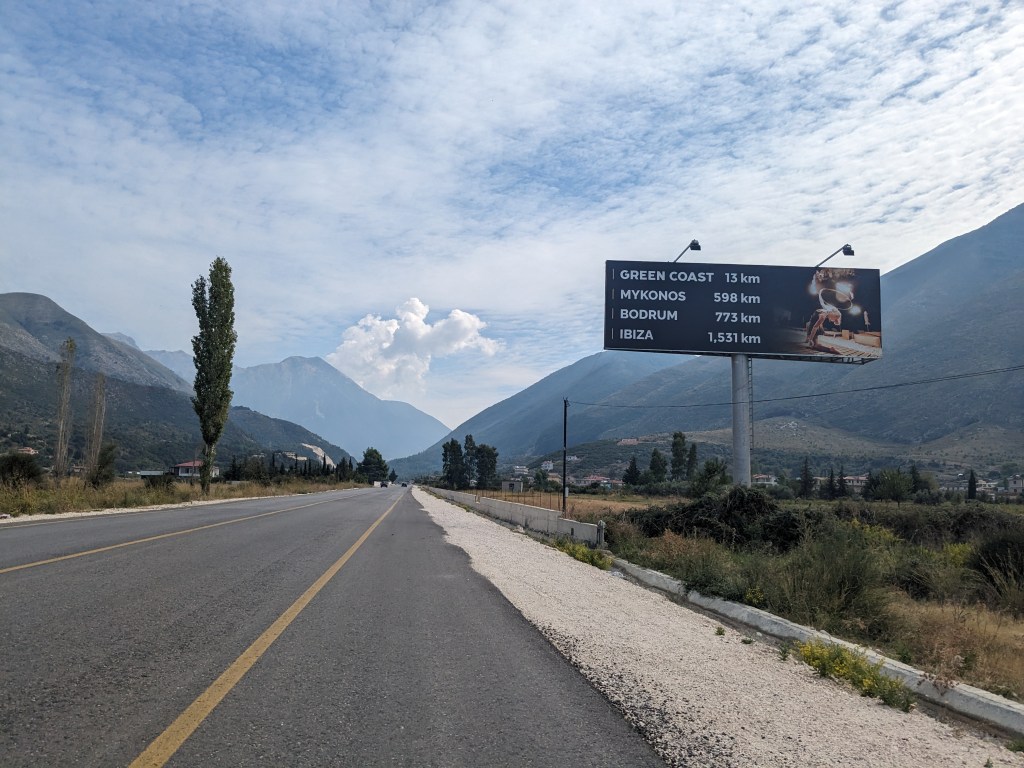
Expectation: Drivers are going to run me off the road!
Totally thought I’d have to worry about drivers not giving enough space but in reality most gave plenty of space.
On the trip through the Balkans, your best friends were semi trucks and most buses because they always ensured they could pass you with space, slowing down and waiting if needed…some even honked to let you know they were there before actually overtaking you on your bike.
Some places have the right idea while others do not, literally two weeks ago at home in the Seattle area (USA) while cycling a semi truck didn´t give me space and passed a few inches from me…like holy shit…not cool! You have no clue how much drag they give off when they go by…literally could have pulled me under (someone find that rude/dumb ass semi driver and shake him conscience please)! From experience cycling in Colombia drivers would rarely give much space to cyclists so I guess that kind of prepared me at least for any close vehicles but in Europe only once did a car get too close (and I´m talking not just my two months but the other 3 or so months of experience I have also cycling around Europe).
Worst drivers were the Zagreb taxis in Croatia and the Albanian young fast as hell drivers in their Mercedes, Audi and VW cars. I swear those were the most desired cars for Albanians and you can add that to their obsession with carwashes!
The worst road I cycled on was the road to Plitvička National Park. This road had no space and was congested on both sides with cars, buses, motorbikes, camper vans/RVs and trucks all day long the whole way. The reason is that this national park is gorgeous and a must see so everyone goes but holy hell was it terrible to cycle and I believe the only way to get there was this flipping road. Interestingly enough around the national park cycling is promoted heavily and there are tons of places to do so but to get there on a bike, pure shit. You find yourself gripping tight to your handlebars and concentrating on staying on the white line the whole time all the while hoping that what I mention next doesn´t happen but knowing it will.
The most dangerous times were when drivers were overtaking from the opposite direction. Sometimes I had to stop dead in my tracks and as far to the side as possible just to be sure they didn’t hit me. The other danger was any driver stupid enough to pass you on a curve…you should never do that to another car so why do it to the cyclist!
On my route I also often felt that each country progressively prepared me for the next. One day of hills in a country prepared you for tons in the next country or riding without bike paths suddenly prepared you for the countries ahead that barely had any. Right, there is a reason things are similar near the border!
Expectation: To do a trip by bike will be low cost.
Budget was 50€ a day for me. Everyone’s budget will vary as you can be super cheap about this adventure and mainly wild camp, cook for yourself, skip most tourist attractions, etc.
I planned to mainly eat out since there were plenty of towns/cities on my route (a.k.a food was widely available) and each country was new to me so I wanted to try their cuisine. In fact, I left my stove and only carried basics – bowl, spoon, etc. The plus to not carrying much food is less weight on the bike. I camped at campgrounds mainly because I liked the safety, wifi, access to charging, showers, toilets and often a restaurant. I also planned to do the tourism aspect while touring so I payed to enter the sites instead of simply riding by most of them…well until the end when I was mainly tired of visiting them. Castle after castle; church after church; ruins after ruins; walled city after walled city….it became redundant and simply too much of the same that interest waned sharply after a few of the same, same.
In the end I averaged $56 USD (53€ at the time) a day for the journey. In total I landed just under $2,500 for nearly 2 months cycling in Europe. I personally think this is fine and I am happy with it because I enjoyed nearly everything I did and saw.
For reference, Bosnia was cheapest, then Albania, then Macedonia (N) and the rest were nearly equal for me cost wise. If we compare costs of bike touring to how most travel Europe then yes it is cheaper and can even be ridiculously cheapest if you don´t include all that I did. Considering even hostels these days in Europe are around 40 Euro (peak season) for a bed in a dorm.

Expectation: Balkan countries don´t have cyclists and are not very interested in cycling.
I expected most countries in the Balkans to not be incredibly into cycling or have the infrastructure for it. This is possibly the one expectation that held up.
Truth is there really were few local cyclists in these countries. When you saw them or ran into them in any way it was exciting. If we leave out Austria, Slovakia and Hungary of all the countries visited, Greece seemed to have the most followed next by Albania and then Croatia.
Again leaving out the first three countries I went through in terms of cycling infrastructure there was very little. Bosnia did have the old rail trail (Ciro trail)/backroad which was excellent going from somewhere past Mostar toward Sarajevo and ending near Trebinje. Albania was surprising as it had bike lanes in cities only and main roads seemed to nearly all have shoulders and then Greece was super random and oddly with the worst roads overall. Then again Greece is still a country you can’t toss paper into the toilet so I guess it makes sense.
Vienna has tons of cyclists, Bratislava surprised me with the amount it had but being a smaller city it obviously wasn’t anything like Vienna. Lastly, Hungary had plenty especially around Lake Balaton!
Expectation: Everyday will be different.
On a tour you are constantly moving. You cycle nearly all day. I did 4-6 hours daily plus stops and breaks that totaled around 10 hours daily moving. Everything should be new and it is but there is a major routine to it. Everyday you cycle and what you see is different and even what you experience is different but everyday you pack up and go cycle around the same distances and then when you reach your spot for the night you set up camp, eat, shower (if you have access), chill, plan next day(s) and then it repeats everyday. There is little change from this routine actually and in reality you have little time for much else with your day.
Many cyclists listen to podcasts or music while cycling…I mean day in, day out alone for hours on end, this makes sense. I preferred to be super present but when it was boring I found myself singing a song, chasing my shadow or simply being with my thoughts. I also took lots of photos ;).
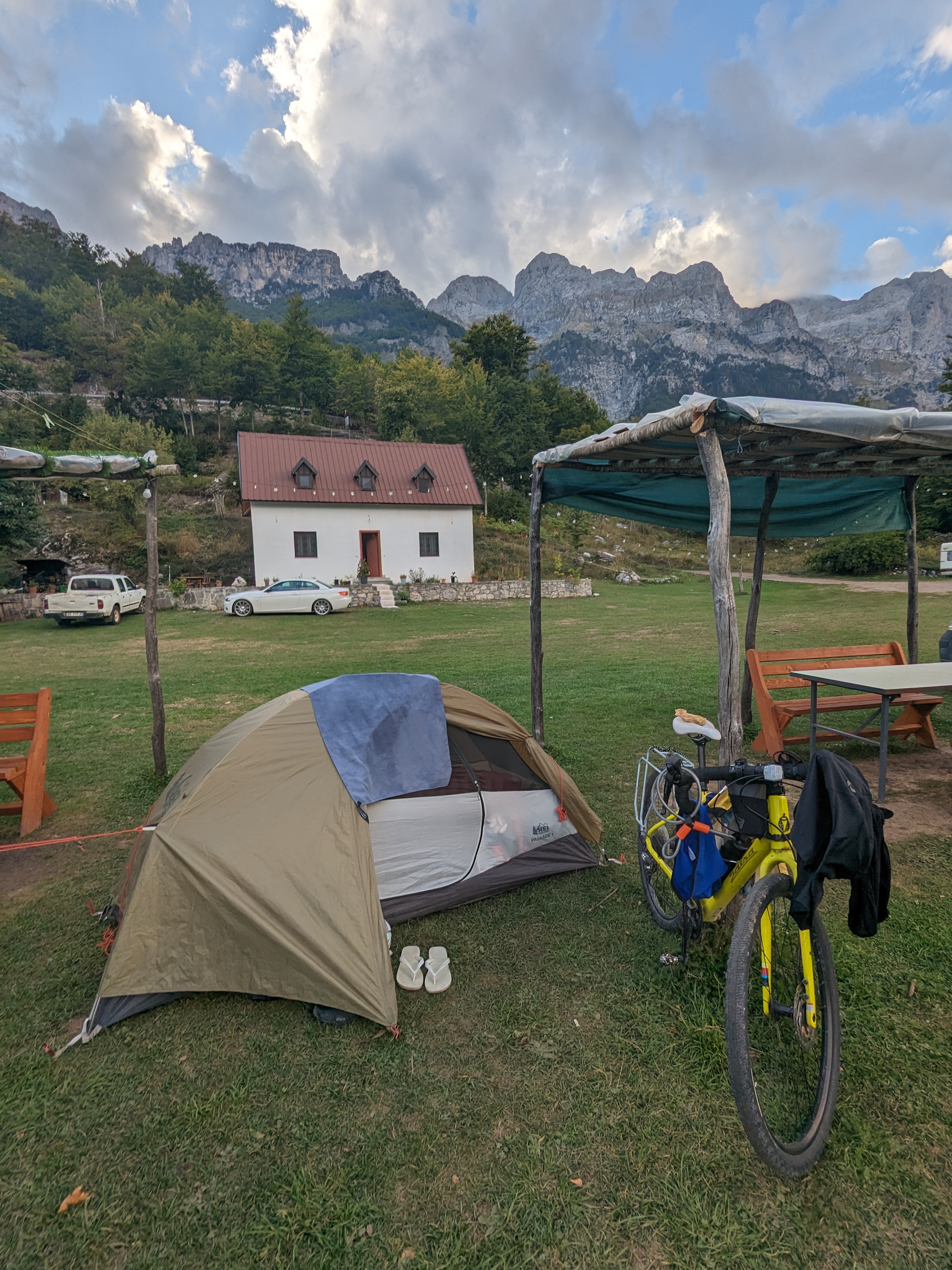
Camping in Albania´s Accursed Mountains – routine is obvious here, camp is set, bike is locked, I´ve showered and bags are off the bike (even stored generally in same spots in/outside the tent)…now time for dinner! 
Camping in Bosnia with a castle on the hill, same routine again though this is in the am now so about to take it down and start the day but first…breakfast!
Expectation: I´m going to meet so many other cyclists touring.
Often I solo travel so with bike touring I never expected to feel as lonely as I did. There are only so many days a human can go without socializing in depth with another human and I believe that to be around the two week mark. Every cyclist I encountered around that time frame seemed to be begging to communicate. Tired of the few brief encounters on the tour you have and ready to eat up as much conversation as possible and meet others. Once you get it you are free again, rejuvenated to pedal as before without problems.
This was definitely the loneliest I’ve ever felt traveling or living abroad!
I met quite a few cyclists but most were headed North, not South like me. If I met others going South, they had a different route/destination entirely so if you cycled together it was for a short period of time or a decision was made to change your route for a bit to enjoy company with that person or group. In total I met 5 cyclists going my direction and got to share quality time with them for a max of 24 hours. There were others I met momentarily along my bike tour in various way and although short I was still able to feel connected to them. These were either other cyclists (or in one case motorcyclists) from campgrounds or tourists I´d meet on walking tours…oddly enough some of these connections I ran in to again elsewhere randomly along my route.

Expectation: This will be a great and unique way to immerse myself into each country´s culture!
Touring by bike can be a great way to travel as you can see so much at a a cruising speed of 13 mph on average. Which by the way is slow enough to see the details of bugs on the road, including ants!
Going through so many countries you would think it would include learning about that culture but it couldn’t be farther from the truth. It was hard to learn words let alone how to pronounce a city’s name because when you are cycling you hardly hear people pronounce it.
What bike touring doesn’t allow much space for is having a cultural immersion. You are constantly moving, not just each pedal stroke but moving towns, camps, cities, countries, places. You can’t immerse yourself and dive as deeply into a culture like this. If you have time you could stay a couple of days in each spot and then you might be able to but eating a meal or chatting with someone at camp or an attraction will only give you so much. The few times I took a bus I actually learned way more! In most big cities I often did a free walking tour which helped gain an understanding of the country and learn a few words at least. What I did learn was a lot about bike culture in each country and bike touring from those I met along the way as they each shared about their experiences.

Expectation: You must be prepared for any repairs.
Well you might want to know the basics but generally the most common problem is fixing a flat tire (patch or change it). For longer, 4 months plus, trips you do need to know more. I had 5 flat tires in those 2 months cycling, most I patched up. I found it much harder to change a flat on a gravel bike than a road bike (they are much tighter tires). I knew others who had tubeless tires and it seems they didn´t have many punctures. If you can’t fix a flat yet you should definitely learn and also practice before going because it is the No. 1 most likely problem you will have. Other than that you might need to change the chain depending on how many miles you do. In Europe most cities have some bike repair shop so other random repairs are fairly easily solvable. The down side is that bike shops in the Balkans might not have all the parts you seek. I met a guy in Zagreb who left his bike in Kosovo and flew to Croatia for a few days with the hope of finding what he needed in order to continue his journey, he needed was new wheels.
Before heading on the trip definitely get a tune up and change any old, potentially soon to fail parts. On the road you can also stop at a shop to have the bike checked out, I did several times. If for some reason you have a bigger problem you can always leave the bike and travel to a larger city to get what is needed. You may want to email or call ahead to be sure the shop can help out before you make that decision and know that you will most likely need a few days (maybe a week) there. I had a surprise problem when the latch on my brand new pannier bag broke. I contacted a store in Croatia and the pannier company and could get the part shipped to their distributor but I didn´t want to wait around so I just made due until returning home.
This does all depends where you decide to cycle because for instance in Africa or South America you would definitely want to know way more about repairs and even have quite a few spare parts on you just in case! Distances are farther between cities and there is likely less help nearby. Terrain might be rougher as well, depending on the route you choose.

Expectation: All the panier bags and weight of the supplies will weight me down.
I worried a lot about carrying so much weight on the bike. I thought it would slow me down a lot.
I was pleasantly surprised once I got going with the bike fully loaded that I could maintain my normal leisurely speeds at which I generally cycle (13 mph/20kmh) and it didn´t feel too different either. Most days I hardly realized I had all the weight, until I stopped riding lol. Adding weight to a bike is noticeable most when the bicycle either falls over, you have to move it or when you have to carry it up stairs (this does happen!) which makes you really have to use your muscles (and gain some quickly in the process ha).
In total, I carried 15 lbs/6.8kg with all my gear (some days more with snacks, etc). Most important and often crucial was to be sure the weight was distributed evenly for a better riding experience and steering control (might need to check this daily, since you live out of the bags). Speeding downhill, especially on gravel, with the weight unevenly distributed, even if slightly, was kind of scary.
I do know if you have more weight than the bike itself that it would slightly lower your overall speed, especially heading up hills. Cyclists on tour for months usually carried all their food and plenty of other stuff and their bikes were as heavy as a pile of bricks (around 70lbs/30kg). Plus many long term cyclists use steel frame touring bikes. My bike, Lemoncello (as I named it), weighs 24 lbs/10kg and is an aluminum bike with some carbon so just a few pounds lighter than the steel steeds (usually closer to 30lbs/13kg).
The most interesting was when you took the bags off and cycled. Such a weird sensation and learning curve when cycling without the gear on the bike…almost feels as though you have a flat tire lol as you sort of swing back and forth a bit wobbly. Not exactly what you want to feel but this is normal.

Expectation: Weather will be great in summer!
Setting off in September and heading South in Europe meant I could expect good temps and fairly stable climate for a couple of months.
I expected this but I went prepared for all weather. Having a down jacket, waterproof gear and thermal gear did come in handy yet there was plenty I never ever touched. It is still best to go prepared for the random weather patterns. Cyclist touring in Greece told me they came the year prior but stopped touring early and flew home because there were so many rain storms and were here again this year for revenge…ha ha.
I got lucky with mainly sun and good temperatures the whole way but I also had a few thunderstorms pass as well and when I headed up into the mountains later on my trip warmer clothes at night were a must!
After getting stuck in a storm unknowingly I started to check the weather a few times a week and if thunderstorms were in the forecast then I planned to have a place to stay and reserved a hotel or airbnb. I did often cycle before storms were expected to arrive. I´d leave earlier than usual because there is no use in losing a good cycling day and distance gained if the storm isn´t there yet. Again, everyone does this different this was just me avoiding stress (because lightning scares me a wee bit) and getting forced rest. I would totally cycle if rain storms where going to last longer but one night inside away from electric snaps from the clouds raging above felt smart.

Expectation: Route will take this many days…
I estimated the distance of my planned route to take one month. It took a bit longer as I sometimes deviated from the route, stuck out a storm in one place or just needed more time off the bike.
The real issue with time though is that I failed to add in my rest days! Ha ha ha
I took a rest day about every 5 days. Everyone does it different but I think 4 days or even 3 days cycling and then a rest day might be a good strategy. This also depends on distances you choose to cycle daily. Most seemed to do 70-100km (43-62 miles) a day but slower riders might do less.
I was generally cycling around 100km (60 miles) a day and I took 14 days off during my 51 day trip. Which made me two weeks overdue on my original estimate of 1 month….you must include rest days in your estimate and it was obvious I did not lol!

Expectation: Because I was touring I could only get places by bike.
You start the trip thinking you can only get places by bike but in reality not everything has to be on the bike and most definitely not everything goes as planned! Days I took off I didn’t touch the bike at all and walked everywhere or occasionally took public transit into a city from camp, etc.
There were places I wanted to visit but by bike it would take longer, be much harder and be off route. I always weighed the options. If for instance the bus takes 2 hours but cycling was 2 days and lots of elevation, I prepared to leave the bike and took the bus or if the bus to somewhere took the same as the bike and it was on the way I deviated and cycled there because why waste time in a bus if in the same time I can do it myself. I always asked about leaving the bike a few days (locked) before actually leaving; it never hurts to ask, and all guesthouse/hotel/airbnb/hostels/campgrounds owners I met were very accommodating.
Cycle touring can be as flexible as you want it to be. Sometimes you need to be somewhere because you reserved a room or you are meeting people and took longer then anticipated so you have to take the train. You can’t be closed minded about the adventure and sometimes you have to accept these moments of not cycling to reach somewhere due to time constraints, health, safety etc. It is totally ok to do these things. Yes, taking the free ferry to Peloponnese in Greece versus cycling the windy bridge is ok!
Now don´t get me wrong there are also times though when you took the transport for whatever reason yet you feel incomplete so you consider returning to cycle it! …Truthfully though you just get over it and accept it for what it was.


If you were hoping to find more typical expectations, I’m sorry, as none of my personal worries or expectations included:
– Soreness (Of course I would be, I went from 1-2 hour rides occasionally to 6/7 hours every day…duh!)
– Finding water (I expected to find water all over from taps and did. I also had my filter as backup and used it 1x.)
– Hilly (The route clearly had mountains and I know it is hard to do a flat bike tour anywhere)
– It’s easy peasy (Always thought it would be challenging as I usually seek that)
– Only for older people (I expected all ages, body types, etc. just like I see in all sports I’ve participated in before and that is what I encountered!)
– Bike works properly (I made sure it was ready to go but went knowing anything could happen)
– Physically prepared (I guess kind of but reality was I just expected to prepare as I rode and gain fitness over time)
– Need to know directions (I used an offline map, had a vague idea of a route and just went. Learning as I went, I downloaded navigation apps as I heard about them and got lost plenty…even with directions/navigation, maps/etc)

Stories from my adventures: Cycling the Balkans: Greece, Albania, Montenegro, Croatia
Statistics Reviewed:
- 51 days cycling (14 days off)
- 2069.6 miles/3330.7 km (+ 6.9 miles/11.1 km from port) = 2076.5 miles / 3341.8 km cycled
- 98889 ft gain/30141.36 m (+328 ft from port)
- 178 hours (47 min from port)
- 5 flat tires
- 1 broken pannier bag
* From Port – meaning I ended my tour at the Port of Athens (Piraeus) then took a ferry to Crete to celebrate. A week later I returned and cycled into the center of Athens. I count the port arrival as my end date for the trip.
 WHERE IN THE WORLD IS TaG
favorites. typical expectation not typical for you “easypeasy”
you didn’t expect nice bike roads in albania but build it and they will come like Tacoma
favorite photos
yay trip victory photo coming into Athens.
Challenged unicyclist, water fountain
Bosnia train window picture
LikeLike